 Some days I feel so much like a cynic, a hardened soul. But when I was asked, "Does your son work better with sticks or carrots?" recently, my idealism aborts its vow to stay hidden and comes back roaring.
"Carrots and st icks are the same," I retort, trying not to sound too snooty, and stopped the words "bribery" and "manipulation" just before they escaped my mouth. "They come after something has been done and typically from an outside source and have very little to do with the task/lesson itself."
In all my years of teaching, motivation has always been the area that has fascinated (and frustrated) me the most. As a teacher, I want a key to the place where motivation resides in my students, to see what's there. As a parent, that desire is intensified a thousand times.
But this is getting away from what I want to write about today.Today, I want to write about writing and motivation, and about now my heart soared when I read the comments on my last post.
In my post, I lamented the unfortunate situation in which writers are told to polish their opening or nobody would notice their manuscripts. Most of us write because we love to or we need to but publishing is a goal as well. And when we read the same advice everywhere, it's hard not to pay heed. Some days, the heed-paying takes its toll. Like many others, I have to continually peek at my motivation and my direction, to make sure I haven't forgotten my primary responsibility is not to get published but to write what I must write.
So, when I saw in my fellow writers' comments that their concern is all about their stories, and not about how to fit into a mold that conventional wisdom insists is, if not the only one, then the best, I felt like weeping.
Listen to how they talk about their work. Scott Bailey said this about beginnings:
My idea is to take the reader by the hand and say, "Hey, let's go have fun" and establish the reader's trust that I have the technique and the imagination to make good on that promise of fun.
Domey Malasarn's explanation about why he couldn't skim on his middles is simple but speaks to the real reason we write: because we care.
The middle is my favorite parts of a book, so I care about it a lot!
And I'm going to think about my endings the way Tanita Davis does from now on:
...leaving a book is so hard. I want the reader to feel the same reluctance to read the last paragraph.
Not a single comment by anyone about doing something to get published. Instead, the focus was on character and relationships and setting. Nobody mentioned anything about carrots or sticks, only the stories. So there, B. F. Skinner et al!
Go, Take heart. Write.
 A number of years ago, I accompanied my husband to a conference in San Francisco. During those pre-kids days, I would typically explore on my own during his meetings and then have dinner together. That time, for some reason, I decided to attend the orientation for families and heard a spiel by a fantastic walking-tour guide. He knew his facts, he presented them in interesting ways, and he was funny. I signed up.
I showed up the next morning, ready to spend a few exciting hours wandering around San Francisco, learning about the secret history and listening to a master story-teller.
 But he wasn't there. He had sent someone else. This person mumbled and swallowed the second half of every other sentence and didn't make the walk interesting at all.
I
felt sorry for her but I also felt cheated. I paid money for a product only to be given something else.
With all the focus on " hooking" agents and editors with the first pages/paragraphs/lines, a lot of writers have polished and re polished the openings till they sparkle. What I wonder is if the rest of our books live up to the expectations set by the opening.
I have overhauled my book so many times that I feel I've given as much scrutiny to my middle and end as I have the beginning. Recently, just as an experiment, I started reading my book in the middle. I was relieved that it didn't feel rushed or meh-worthy. Of course I am not unbiased, despite the objectivity I managed to acquire by having left the book aside for a long time, but to the best of my knowledge and ability, I'm not doing a bait-and-switch.
To my writer friends: how do you overcome the temptation of focusing too much on the beginning and not enough for the rest? Or is it even a temptation?
A thought has been niggling at me for a very long time with regards to my middle grade novel. And I am finally surrendering to its rightness.
You see, the book takes place in Malaysia. But as I have been primarily targeting American audiences, I've written it using American English instead of the way English would be spoken in Malaysia. I've also made sure that I explained, subtly, of course, cultural etiquettes and norms.
But for a while now, I've been thinking that I need to write a version of it that targets Asian audience. Several things have happened recently, including being shortlisted for the Scholastic Asian Book Award and talking to some authors I met at the Asian Festival of Chilldren's Content, that have convinced me that it is an excellent idea.
Except now I am pushing through my YA novel, trying to get a first draft finished before too long and the mere thought of going back to a work I had revised about 1700 times just makes me reach for the closest bar of chocolate.
But I know it has to be done. I just need to prioritize and be more organized about my time. My forte. Right.
*Heads to pantry to secret stash of chocolate*
Kung Fu Panda II rocks.
I was thoroughly impressed with the art (don't miss the closing credits,) the humor, the kung fu moves (the peacock has some of the coolest ones; wish I had fan-like tail feathers,) the characters, the way 3D is used, the orchestration of the film score (yes, noble french horn sections and exciting timpani parts!) the theme, the excellence, the heart.
[Warning: minor spoiler alert]
I enjoyed all of these so much that it was very easy to overlook the flaws. For example, Po's kung fu prowess seems inconsistent. He vacillates between the overweight panda who doesn't even have the stamina to climb stairs and the mighty Dragon Warrior impervious to any kung fu or weapons. I had to rely primarily on musical cues to know when Po would win and when he would bumble. It would have been better if his degree of mastery is more integral to the story. If I am to believe he can single-handedly, even within the context of a suspended belief system, rescue his heavily bound and guarded fellow warriors, I don[t think I can accept he is so easily defeated by Tigress.
But even typing this makes me feel petty. The movie is so well-made, so entertaining (I laughed out loud several times and found myself grinning often,) and the experience so wholly engaging that these things really didn't matter.
So how can I make my stories so engaging my readers will overlook the flaws? Of course it doesn't mean that I am not going to do everything I can to make sure there are no avoidable flaws. But when is a reader so bought into the story that s/he is willing to follow?
What's your take? Well-developed characters? Technical excellence? Memorable setting?
[In case you're w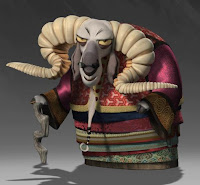 ondering about the title of this post: Michelle Yeoh voices the character of the soothsayer, who is a female ram. With a beard. Yeah.]
I finished a thriller/suspense novel a little while ago and am not sure what to make of it. I enjoyed the first third, but by the middle of the book, I had lost interest. I finished the book just to see if the ending would capture my attention again. It didn't.
The writing is good and the plot interesting, but the characters' motivations remained unaddressed. I followed along, despite not knowing why this character would go there and that character would turn up here, but I felt like a small child being told to stay quiet and not ask any questions on a long and complicated journey using multiple modes of transportation. It went from being frustrating to infuriating to numbing.  This experience made me think about the importance of motivation in a story. Why do characters do what they do? Are they confined by their personalities: a loving person cannot help but choose the loving thing and a curious person cannot help but seek out answers? Are they succumbing to circumstances? Sophie had to choose one child or the other. Are their actions solely dictated by plot?
I don't mean that we need to know at every point why a character would something. Keeping it hidden for a while keeps the readers intrigued. Keeping some motivations hidden the entire time makes the reader ponders even after the book ends. But keeping almost all the motivations hidden most of the time makes a story just a series of arbitrary events.
Why would any reader care?
How much tolerance do you have for not knowing why characters do things in a book? Have you read a book that frustrated you this way?
I chose not to do NaNoWriMo because I wanted to celebrate my birthday and my favorite holiday, Thanksgiving, without having the word count over my head. I also needed to concentrate on my WIP, a YA novel I had started three times without being able to go past a particular point.
November is now over. Its December 1st and I don't have that much to show for it. No planning, no specific goals: that was my problem.
When The Rejectionist invited her readers to do a Pre-Resolution, a mini one before embarking an a full-blown I will exercise an hour everyday and eat only raw fruits and will treat everyone with the utmost respect and work for world peace type thing on New Year's Eve, I answered the call.
Small is good. One month is doable. I am in. Here are my pre-resolutions:
- Every weekday at 10 a.m. I will be working on my YA novel. Actual writing, no research, no brainless switching sentences and words around or other busy but useless work.
- Every weekday at 2:30 p.m. I will be practicing piano. My solo gig in August doesn't seem that far away anymore.
- In Tae Kwon Do, I have a midterm coming up in less than a week and a national tournament in 6 1/2 weeks and I have specific training plans I've drawn up that I will stick to.
- I will stick to my (more reasonable, less ambitious) house cleaning plan.
You are welcome to nudge or remind or ask me questions.
 Some days I feel so much like a cynic, a hardened soul. But when I was asked, "Does your son work better with sticks or carrots?" recently, my idealism aborts its vow to stay hidden and comes back roaring.
 icks are the same," I retort, trying not to sound too snooty, and stopped the words "bribery" and "manipulation" just before they escaped my mouth. "They come after something has been done and typically from an outside source and have very little to do with the task/lesson itself."


